
Startups
March 6, 2026
How Much Does a Professional Website Cost in 2026? A Practical Pricing Breakdown

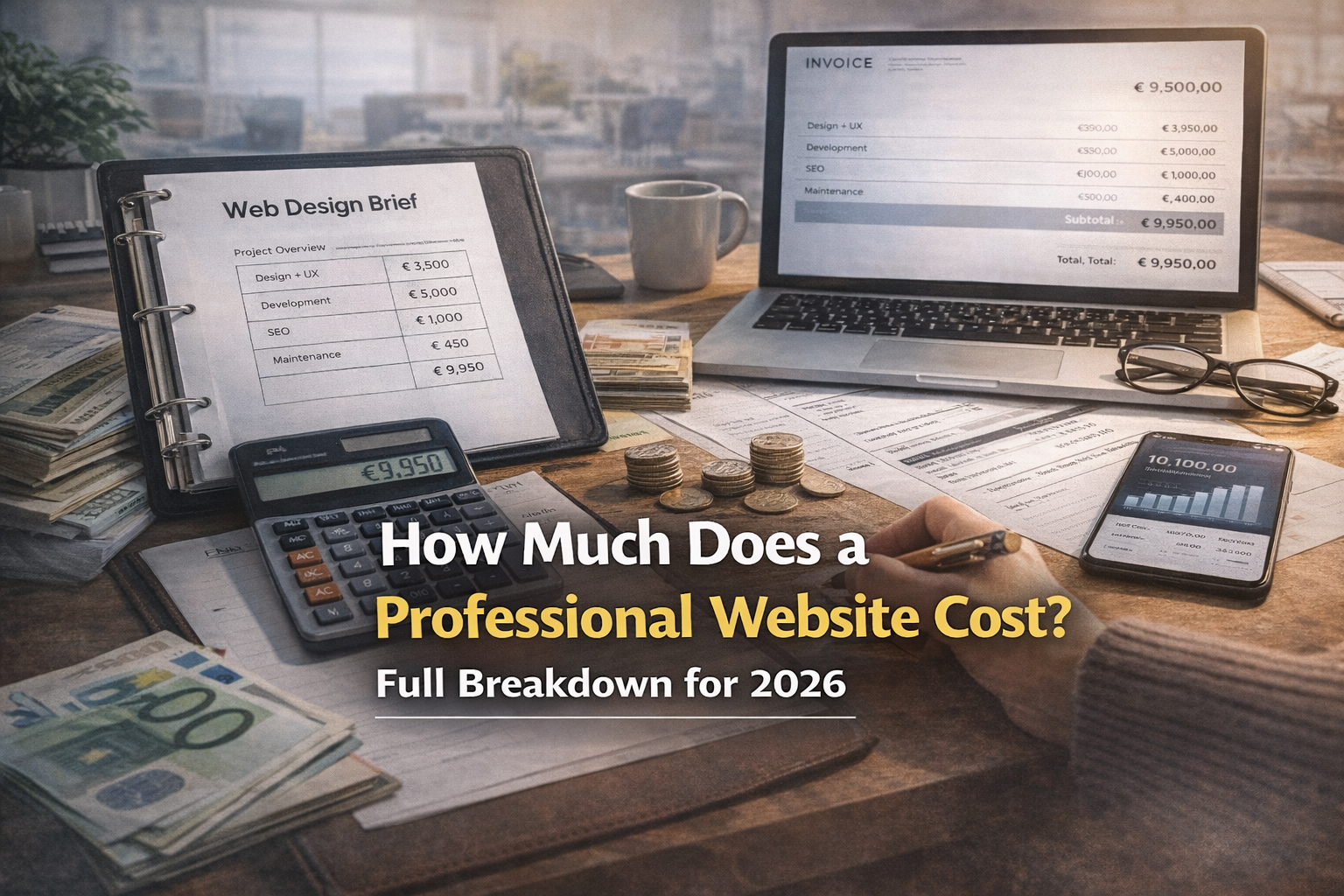
Website pricing feels confusing because people compare totally different things: a template site, a custom marketing site, and a product-grade build — all under the label “a website”.
This guide explains what actually drives cost in 2026, what you get at different budget levels, and how to avoid paying twice.
The three buckets of website cost
1) DIY / builder sites
Fast and cheap, but limited in differentiation. Best for early validation, not for competitive markets.
2) Professional marketing websites
The sweet spot for most businesses: strong design, clear messaging, fast performance, CMS, and conversion structure. Industry guides commonly describe professional design starting at a few thousand and scaling with complexity. citeturn0search0turn0search13
3) Custom web platforms (website-as-software)
When the website includes product logic, heavy integrations, or custom applications. This is engineering work, not just “design”.
What drives the price (the real variables)
- Scope: number of unique pages, templates, CMS collections
- Messaging + copywriting: strategy and writing time matters
- Custom design system: components, responsive rules, interaction design
- Integrations: CRM, email automation, analytics, payments
- Performance requirements: speed, Core Web Vitals, technical SEO
- Stakeholders: more decision-makers usually means more rounds
Budget ranges (use as a planning tool)
Costs vary widely by scope and quality level. Many industry breakdowns place basic small-business builds at the lower end and complex redesigns far higher. citeturn0search9turn0search13
- Starter marketing site: strong template + light customisation
- Custom marketing site: bespoke design + CMS + conversion structure
- Complex builds: advanced CMS, integrations, multilingual, heavy interactions
Tip: budget for post-launch optimisation. The best ROI usually comes from iteration, not launch day.
How to avoid paying twice
- Don’t start design before your structure and messaging are clear.
- Don’t “wing it” on SEO migration during a redesign.
- Don’t ship heavy animations that slow the site down.
- Don’t underestimate content production (photos, copy, case studies).
FAQ
Is Webflow cheaper than WordPress?
It can be more predictable. WordPress can be cheaper upfront, but maintenance and plugin complexity often add hidden costs.
What’s the biggest cost multiplier?
Custom functionality and unclear scope. The more “moving parts,” the more time required for QA and iteration.
Should I choose an agency or freelancer?
Freelancers can be great for smaller scope. For complex projects, a studio can reduce risk through process, QA, and broader skill coverage.
Next step
If you want a realistic estimate, we can scope your project quickly and give you a clear breakdown of what impacts cost — and where you can simplify without sacrificing quality.
[Internal Link: Contact]

.svg)
.svg)
